
✍️ My Experience
When I look at a short German post like this one, I don’t just see an event
invitation—I see a complete learning opportunity. As a language learner,
I’ve realized that even a simple message about a group activity can teach a
lot about real communication.
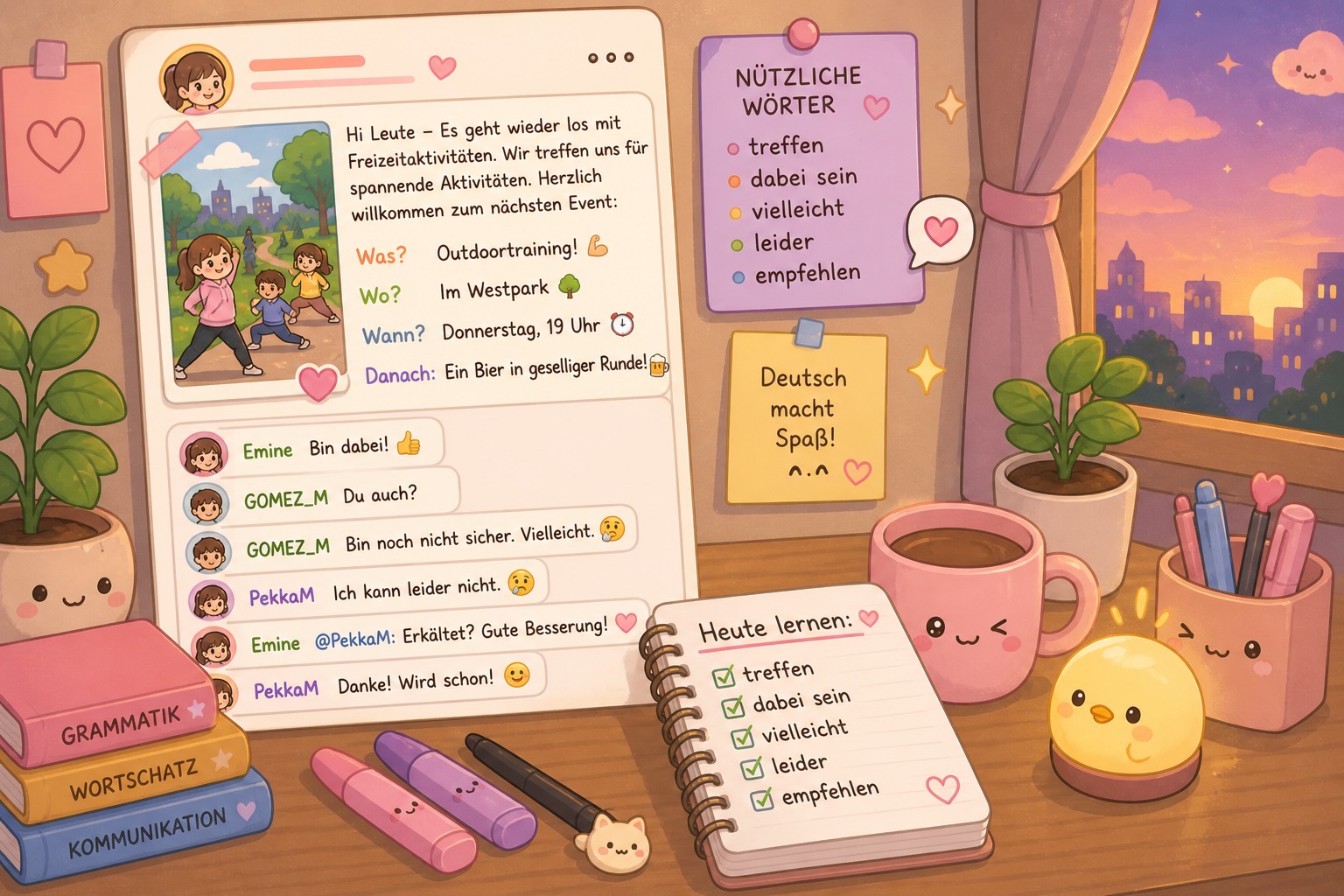
In this example, the post announces a local activity. It tells people what
will happen, where it takes place, and when it starts. For example:
„Was? Outdoortraining!“
„Wo? Im Westpark“
„Wann? Donnerstag, 19 Uhr“
This structure is very practical. It shows how information is often
presented clearly and directly in German.
——————————
🧩 Why This Type of Text Is Useful
From my perspective, this kind of post is perfect for learning because it
reflects real-life situations. It’s not complicated, but it’s meaningful.
First, I learn how to organize information. The text uses simple questions
and answers—Was? Wo? Wann?—which is a common way to structure announcements.
Second, I see how people interact. In the comments, different reactions
appear:
–
Someone writes: „Bin dabei!“
–
Another says: „Vielleicht.“
–
Someone else writes: „Ich kann leider nicht.“
These short sentences are extremely important. They show how people accept,
hesitate, or decline invitations in everyday German.
——————————
💬 Understanding Social Interaction
What I find especially interesting is how people respond to each other.
When someone says they are sick or cannot come, another person replies
politely:
„Gute Besserung!“
This teaches me not only language but also social behavior. I learn what is
appropriate to say in certain situations.
It also shows that communication is not just about grammar—it’s about
connection.
——————————
📘 What I Learn From This
1. 📅 How to Share Information Clearly
Using simple structures like Was, Wo, Wann makes communication easy to
understand.
——————————
2. 🗣️ How to Respond to Invitations
I learn useful phrases like:
–
„Ich bin dabei.“
–
„Vielleicht.“
–
„Ich kann leider nicht.“
——————————
3. 🤝 Social Language Matters
Expressions like „Gute Besserung!“ help me sound natural and polite.
——————————
4. 🧠 Learning Through Context
Instead of isolated words, I learn language in a real situation, which
makes it easier to remember.
——————————
5. 🚀 Progress Across Levels
At a beginner level, I understand basic details.
At higher levels, I understand tone, intention, and interaction.
——————————
🎯 Final Thought
For me, this kind of short, everyday text is one of the best ways to learn
a language. It is simple, realistic, and full of useful expressions.
It reminds me that learning German is not just about studying rules—it’s
about understanding how people actually communicate.

Leave a Reply