
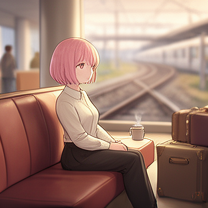
My First Time Navigating the German Transportation System: Airport and Bahnhof Blues
Okay, so, this is a tough one to write, but also a really important one. Moving to Berlin has been…well, an adventure. A big adventure. And a huge part of that adventure has been dealing with the German public transport system – especially airports and train stations (Bahnhöfen!). Honestly, the first few times were a complete mess. I felt like I was constantly shouting random words and utterly lost. Let me tell you a bit about what I learned, the mistakes I made, and maybe – hopefully – some things that will help you if you’re facing a similar situation.
Initial Panic: Arrival at Flughafen (Airport)
My first trip was to Munich. I was so excited, really hyped up about seeing my family. I’d practiced saying “Ich komme, um Sie zu besuchen” (I come to visit you) a hundred times, but as soon as I got through security, everything went sideways. I needed to buy a ticket, and I panicked. I tried to ask for help, and I blurted out, “Wo ist der Bahnhof?” (Where is the train station?) completely oblivious to the fact I was at the airport! The poor woman behind the counter just stared at me, and another passenger, a very kind older man, gently corrected me. He said, “Sie sind im Flughafen, meine Liebe” (You are in the airport, my dear). That was my first real “aha!” moment.
Key Phrases to Learn Immediately:
- “Ein Ticket, bitte.” (A ticket, please.) – Absolutely essential!
- “Ich brauche einen Ticket nach…” (I need a ticket to…) – Be prepared to say where you’re going.
- “Wo ist der Bahnhof?” (Where is the train station?) – Useful, but only when you’ve realized you’re in the wrong place!
- “Entschuldigung, können Sie mir helfen?” (Excuse me, can you help me?) – Always a good start.
Bahnhof Confusion: Getting Lost in the Maze
After Munich, I managed to make it to Berlin Hauptbahnhof (Main Train Station). It’s… enormous. Seriously, it’s a labyrinth. I was trying to find platform 8 for my regional train to Potsdam, and I just kept wandering around, completely lost. I kept asking people, “Wo ist die Bahn für Potsdam?” (Where is the train for Potsdam?) and getting increasingly complicated directions. Someone actually pointed me to a floorplan displayed on a screen – a lifesaver! I learned quickly that people in Germany are generally helpful, but they don’t always speak slowly or use simplified language, especially if you’re clearly struggling.
Important Vocabulary for Train Stations:
- Bahnhof (Train Station) – Obviously!
- Platte (Platform) – Don’t confuse this with “Pfanne” (pan).
- Zug (Train)
- Richtung (Direction)
- Fluß (River) – The Hauptbahnhof has a river running through it.
Common Mistakes (and How I Made Them)
I think the biggest mistake I was making early on was assuming everyone would speak perfect English. While many younger people do, particularly in Berlin, I quickly realized that relying on English entirely was a recipe for frustration. I also wasn’t paying close enough attention to signage. The German signs are often very detailed and, frankly, overwhelming if you’re not used to them. I once spent ten minutes trying to decipher a sign about baggage allowance – it turned out to be a very elaborate diagram!
- My biggest ‘oops’ moment: I tried to buy a coffee at a kiosk in the station and asked for “ein Kaffee, bitte” (a coffee, please) without specifying how I wanted it. I got a huge, lukewarm, black coffee with milk – a disaster! I learned to add “mit Milch” (with milk) or “mit Zucker” (with sugar) the first time.
A Small Victory: A Successful Journey
After a few chaotic starts, I started to get the hang of things. I learned to read the departure boards (Abfahrtsanzeige), to understand the platform numbers, and to say “Bitte, können Sie mir den Weg zum Bahnsteig zeigen?” (Please, can you show me the way to the platform?). And, crucially, I started carrying a small notebook and pen to jot down key directions.
I eventually made it to Potsdam – exhausted, slightly bewildered, but triumphant. It felt amazing.
Final Thoughts & My Advice:
Don’t be afraid to make mistakes. Seriously, everyone makes them. Don’t be embarrassed. Learn a few basic phrases, be polite, and most importantly, observe how other people do things. The German transportation system is complex, but with a little patience and effort, you’ll manage. And who knows, you might even start to enjoy the adventure of navigating it! “Viel Glück!” (Good luck!)

Leave a Reply