
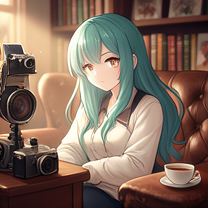
My Journey into German Through Photography and Art
Okay, so, here I am. Six months in Berlin, and let me tell you, it’s wild. I came over to work as a freelance translator – mostly technical stuff, thankfully, because my German is still… well, let’s just say it’s a work in progress. But the biggest, most surprising thing? I’ve been completely sucked into the local art scene, and it’s forcing me to learn German in a way that feels actually useful, not just rote memorization. It started with a casual interest, but now it’s become a really important part of my life.
First Impressions: The Gallery and the Confusion
The first gallery I went to was called “Atelier Licht.” (That’s “Workshop Light” in German, by the way – I learned that!). It was amazing, really powerful photography – lots of black and white portraits, very evocative. I wanted to ask the guy behind the counter, a man with a really bushy beard, about one particular photo, a huge print of a rainy street scene. I started with, “Entschuldigung, ich mag dieses Foto sehr. Wie heißt es?” (Excuse me, I like this photo very much. What is it called?)
He looked at me, confused. “Wie heißt… was?” he asked, completely bewildered. Turns out, I’d used the wrong phrase. The correct way to ask is, “Wie heißt das Foto?” (What is the photo called?). Small mistake, huge frustration, especially when I’d been so careful with my German phrases! He eventually understood, and patiently explained that “das Foto” is the correct word for the picture. That was my first lesson in the importance of precision, and I made a note to myself: always double-check my vocabulary.
Talking About Art – Key Phrases and Vocabulary
I quickly realized that talking about art in German is a whole different ballgame. It’s not just about saying “I like it.” You need a way to describe what you’re seeing, what you’re feeling. Here are a few phrases that have become essential:
- Ich finde es schön: (I find it beautiful) – A good starting point!
- Es ist sehr beeindruckend: (It is very impressive) – Useful for really powerful works.
- Die Farben sind wunderschön: (The colours are beautiful) – Especially important when discussing paintings.
- Ich mag die Komposition: (I like the composition) – This is a big one! Germans really appreciate good composition, especially in photography.
- Es hat eine starke Wirkung: (It has a strong effect) – To describe emotional impact.
I’ve been practicing these phrases constantly. I even overheard a group of people discussing a modern art installation – it was a giant, rusted metal sculpture. They were saying, “Es ist total abgedreht!” (It’s totally crazy/weird!), which I quickly learned is a common way to describe unconventional art.
My Photography Group: “Die Kreativen” (The Creative Ones)
I joined a small photography group called “Die Kreativen” – seriously, it’s a great name. They meet every week in a small café near Prenzlauer Berg. It’s been amazing for my German, and for my photography skills too.
Last week, we were discussing our latest shoots. One of the guys, Max, showed us some photos he’d taken of the East Side Gallery. He said, “Ich habe versucht, die Atmosphäre einzufangen.” (I tried to capture the atmosphere.) I immediately responded, “Das ist eine tolle Idee! Aber ich finde, die Farben sind zu dunkel.” (That’s a great idea! But I find the colours are too dark.) Max laughed and said, “Ja, das stimmt! Ich muss mich verbessern.” (Yes, you’re right! I need to improve.) We were debating the merits of black and white versus colour for capturing the history of the wall – a very German conversation!
Navigating Misunderstandings (And Laughing)
There have been a few other hilarious moments. I was trying to buy a print from a small gallery owner, Herr Schmidt. I wanted to ask about the printing process, because I’m a bit of a nerd about photography. I started explaining, “Ich interessiere mich für die Drucktechnik… die Auflösung…” (I’m interested in the printing technique… the resolution…). He stared at me blankly. A friend translated for me: “Er wollte wissen, ob der Druck von Hand gemacht wurde!” (He wanted to know if the print was made by hand!). Turns out, ‘Auflösung’ just means ‘resolution’ – pixel resolution! I felt my face turn red.
Moving Forward – Connecting Through Art
Despite the awkward moments and the occasional vocabulary confusion, I’m starting to feel more confident in my German. Talking about art – about beauty, about emotion, about technique – it’s forcing me to use the language in a way that feels authentic. It’s not just about ordering coffee or asking for directions. It’s about connecting with people, sharing a passion, and slowly, but surely, building a life here in Berlin. And who knows, maybe one day I’ll even have an exhibition of my own! “Die Kreativen” has already started talking about it. “Vielleicht ein Ausstellung?” (Maybe an exhibition?) they asked. I just smiled and said, “Ja, vielleicht!” (Yes, maybe!).

Leave a Reply