
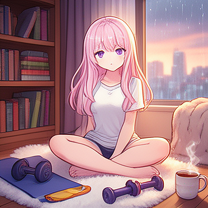
Deutsch und Die Couch: My Journey to Fitness Goals
Okay, so here I am, almost a year in Berlin, and let’s be honest, the first few months were… a blur. Amazing, incredible, overwhelming – but mostly a blur of trying to figure out my life, my job, and, let’s face it, my body. I’d arrived with the best intentions, picturing myself effortlessly cycling through parks, but reality hit hard. I was spending my evenings on the couch, watching Netflix, and feeling incredibly guilty. Then, a few weeks ago, I realised I needed to actually talk about it – my fitness goals, that is – and that’s when I realized how much I needed to improve my German to actually achieve them.
The First Conversation: Meine Fitnessziele
The first hurdle was just talking about it! I’d been avoiding going to the gym, telling myself I was “zu beschäftigt” (too busy). But a friend, Lena, noticed. She said, “Du musst etwas gegen die Couch tun! Das ist nicht gesund!” (You need to do something against the couch! That’s not healthy!). I mumbled something about wanting to get fitter, and she immediately asked, “Was sind deine Fitnessziele? Was willst du erreichen?” (What are your fitness goals? What do you want to achieve?).
I panicked. I blurted out, “Ich… ich will… fit sein!” (I… I want… to be fit!). Lena laughed, a really kind, encouraging laugh. “Das ist ein guter Anfang, aber wir müssen genauer sein,” (That’s a good start, but we need to be more precise). She explained that Germans are very specific about things like weight, distance, and time.
Essential German Phrases for Fitness
So, I started learning some key phrases. Here’s what I’ve found really useful:
- Ich möchte… (I would like to…) – This is my go-to for expressing a goal. “Ich möchte 3 Mal pro Woche ins Fitnessstudio gehen.” (I would like to go to the gym three times a week.)
- Wie viel… (How much…) – Crucial for talking about time and intensity. “Wie viel Zeit hast du pro Training?” (How much time do you have per workout?)
- Ich will… (I want…) – Okay, I use this sometimes, but it can sound a little demanding!
- Ich bin Anfänger/in (I’m a beginner) – Always helpful when explaining your starting level. “Ich bin Anfängerin im Krafttraining.” (I am a beginner in strength training.)
- Kann ich das machen? (Can I do that?) – Useful when asking for guidance or modifications.
Misunderstandings and Corrections
This is where things got really interesting. I once tried to tell the guy at the juice bar, “Ich brauche viel Protein!” (I need a lot of protein!). He looked completely baffled and asked, “Warum? Bist du Bodybuilder?” (Why? Are you a bodybuilder?). Turns out, in Germany, asking for a lot of protein just seems… odd. I learned to say, “Ich möchte eine gesunde Ernährung.” (I would like a healthy diet) – it’s much more natural.
Another time, I tried to explain I was training for a “5km Lauf.” (5km run) to a colleague, and he looked at me like I was crazy! He explained that “ein 5km Lauf” is a very serious thing in Germany, and I should probably start with something smaller. “Fange mit einem kurzen Spaziergang an!” (Start with a short walk!).
Talking About Progress: Fortschritte
It’s not just about setting goals; it’s about talking about progress. Lena and I started checking in with each other. “Wie lief dein Training gestern?” (How did your training go yesterday?). “Ich habe 20 Minuten Yoga gemacht” (I did 20 minutes of yoga). “Das ist toll! Weiter so!” (That’s great! Keep it up!). “Ich habe 30 Minuten Cardio gemacht.” (I did 30 minutes of cardio). “Super! Ich bin schon am überlegen, ob ich mit dir laufen möchte.” (Super! I’m already considering if I want to run with you).
Finding a Local Trainer – Ein Personal Trainer?
I’ve started considering getting a personal trainer – a “Personal Trainer”. I asked a friend, “Kennen Sie einen guten Personal Trainer in der Nähe?” (Do you know a good personal trainer nearby?). He recommended someone called Klaus. I practiced saying, “Ich suche einen Personal Trainer, der mir beim Abnehmen helfen kann.” (I’m looking for a personal trainer who can help me lose weight). Klaus spoke slowly and clearly, and I even managed to understand most of it!
My Next Steps (und meine deutsche Vokabular!)
I’m still very much a beginner, but I’m making progress. I’m actively learning more German vocabulary related to fitness: “Krafttraining” (strength training), “Cardio,” “Flexibilität” (flexibility), and “Ernährung” (nutrition). And, most importantly, I’m learning to communicate my goals and progress clearly. “Ich muss weiter üben!” (I need to keep practicing!). I might still be on the couch sometimes, but now I have the words – and the motivation – to change that.
Ich hoffe, das hilft! (I hope that helps!)

Leave a Reply