
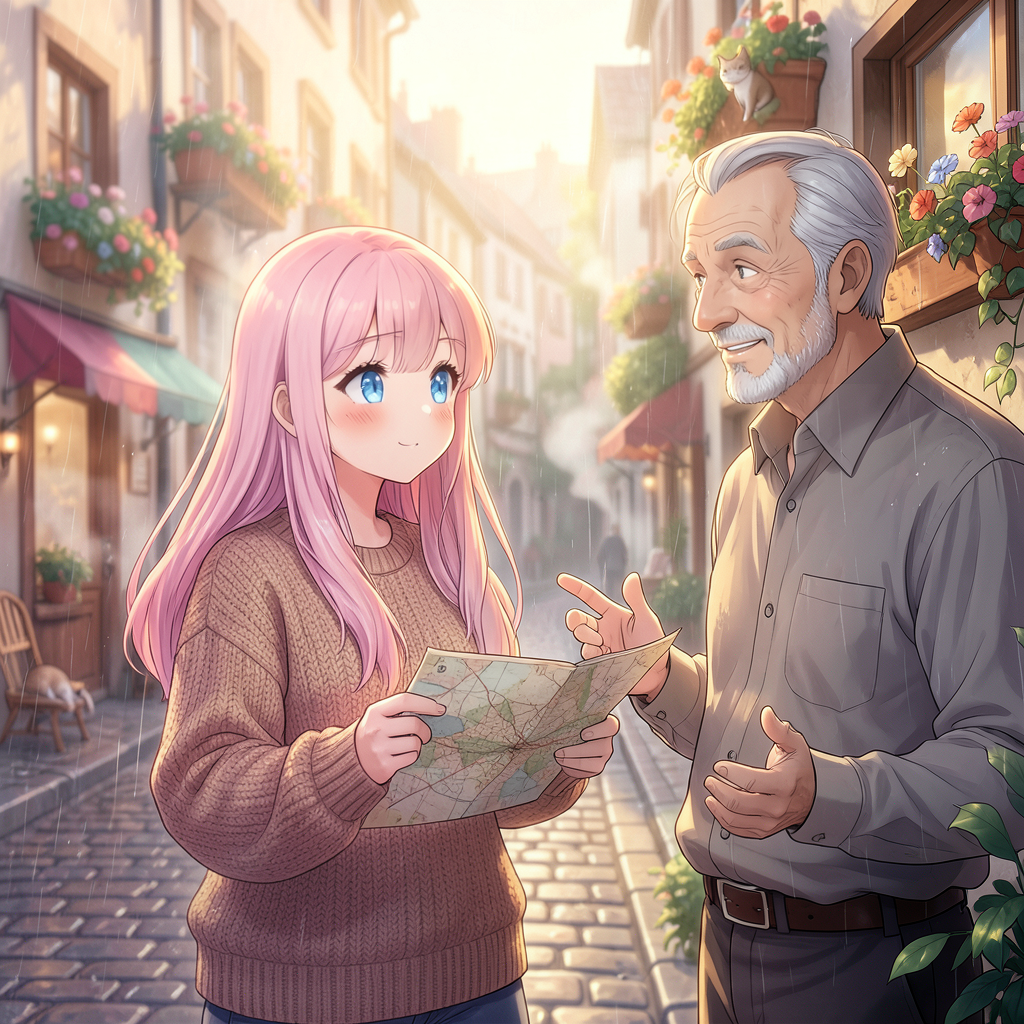
My First Stumbles: Learning to Ask for Directions in Germany
Okay, deep breath. Moving to Berlin was… a lot. I’d pictured romantic cobbled streets and polite conversations, and while there’s definitely some of that, the first few weeks were mostly a frantic scramble to just, you know, function. And let me tell you, asking for directions was my biggest, most embarrassing hurdle. I’m pretty confident I confused more locals than I helped them, at least initially.
The Initial Panic: “Wo ist…?”
The first time I needed to ask for help, I was completely lost in Prenzlauer Berg. I was trying to find a small bakery I’d seen online – “Bäckerei Schüller” – and I was sweating. I approached a woman walking her dog and, in a rush, blurted out, “Entschuldigung! Wo ist… Bäckerei Schüller?” (Excuse me! Where is… Bäckerei Schüller?).
She looked at me with this incredibly kind, slightly bewildered expression. She spoke rapidly in German, and I just stared back, completely blank. It turned out I’d butchered the pronunciation of “Schüller” – it sounded less like a baker and more like a sneeze! Thankfully, she patiently repeated it slowly, “Schüller, ja? Die Bäckerei Schüller, ist hier geradeaus weiter.” (Schüller, yes? The bakery Schüller, is straight ahead).
Key Phrases You Actually Need
That experience hammered home a few crucial phrases. It wasn’t just about saying “Wo ist…?” (Where is…?). It was about building a simple sentence. Here’s what I quickly learned:
- “Entschuldigung, ich habe mich verlaufen.” (Excuse me, I’ve gotten lost.) – This is essential. It shows you’re apologetic and acknowledging you need help.
- “Könnten Sie mir helfen?” (Could you help me?) – A polite way to ask for assistance.
- “Ist es weit?” (Is it far?) – Very useful to gauge the distance.
- “Geradeaus?” (Straight ahead?) – This was a phrase I repeated a lot because I had absolutely no idea how to interpret maps!
My First Misunderstanding (and How to Avoid It)
A few days later, I was trying to reach the Hauptbahnhof (Central Station) from my apartment in Moabit. I asked a man in a cafe, “Entschuldigung, wo ist der Hauptbahnhof?” (Excuse me, where is the Hauptbahnhof?). He looked completely confused and said, “Der Hauptbahnhof? Hier ist nur ein kleiner Supermarkt!” (The Hauptbahnhof? There’s only a small supermarket here!).
Turns out, I’d accidentally walked past the actual Hauptbahnhof, which is a massive building. He was pointing me to a small convenience store a block away. It was a moment of pure panic, but it highlighted the importance of listening carefully and double-checking. I quickly realized I needed to pay more attention to the landmarks he was describing, not just the name.
Practical Tips & Local Customs
- Don’t Be Afraid to Gesture: Seriously, people understand gestures! Pointing at a map, drawing a quick sketch of what you’re looking for, or just mimicking walking can often bridge the language gap.
- Use “Bitte” (Please) and “Danke” (Thank You): This seems obvious, but it makes a huge difference in how people respond.
- Start Simple: Begin with asking for directions to a specific place, rather than just saying “Wo ist…?”. “Ich suche die Technische Universität.” (I’m looking for the Technical University.) is much clearer than just “Wo ist das Technische Universität?”
- Listen for Adjectives: Pay attention to words like “rechts” (right), “links” (left), “gegenüber” (across from), and “direkt” (directly). These are your best friends! For example, “Gehen Sie zwei Blöcke rechts und Sie sehen ein rotes Haus, dann sind Sie da.” (Go two blocks on the right and you’ll see a red house, then you’ll be there.)
My Progress (and My Ongoing Struggle)
I’m still far from fluent, and I still get hopelessly lost occasionally. But I’m slowly getting better. I’ve started carrying a small notebook and writing down key phrases. I’m also practicing pronunciation with apps and, embarrassingly, repeating things to myself in the mirror.
The biggest change has been confidence. I’m still hesitant, but I’m no longer paralyzed by fear of making a mistake. Asking for directions has become a small, daily adventure – and, surprisingly, a valuable way to connect with people. Now, if you’ll excuse me, I think I’m about to get lost again. “Entschuldigung! Wo ist die Bushaltestelle?” (Excuse me! Where is the bus stop?) Wish me luck!

Leave a Reply