
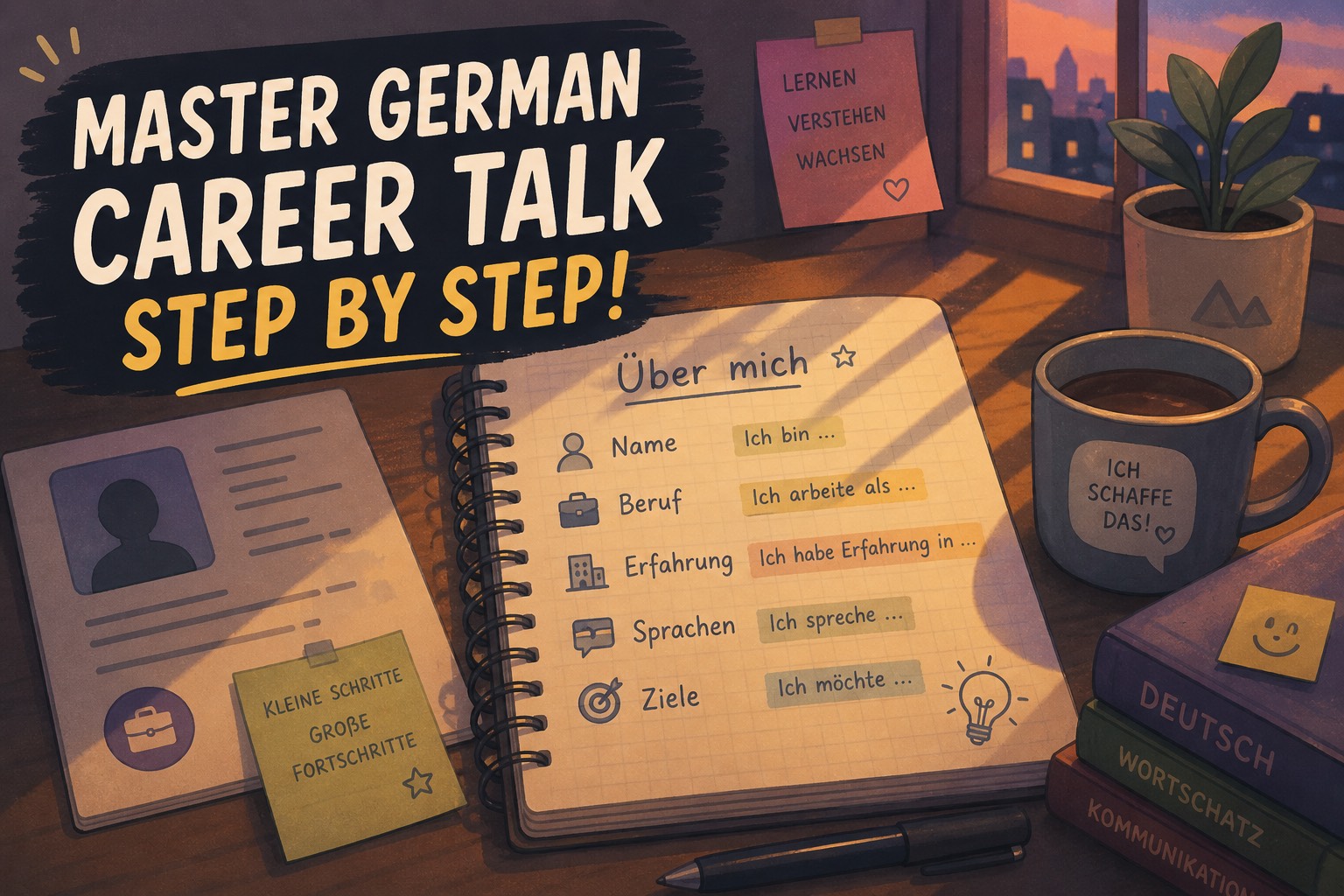
When I started improving my German, I realized that real progress didn’t
come from memorizing vocabulary alone. What helped me most was reading
short, realistic texts—especially personal introductions and career
profiles. These types of texts are simple, structured, and full of useful
language that I can apply in everyday situations.
——————————
📌 1. I Focus on Structure First
When I read a profile, I don’t try to understand every word immediately.
Instead, I look at the structure:
–
introduction
–
job or profession
–
past experience
–
current situation
–
future plans
For example, I might see sentences like:
–
„Mein Name ist …“
–
„Ich arbeite als …“
–
„Ich habe Erfahrung in …“
👉 This structure repeats in many texts, which makes it easier to follow.
——————————
📌 2. I Learn Key Sentence Patterns
Instead of learning random words, I focus on useful sentence patterns:
–
„Ich arbeite im Bereich …“ → I work in the field of …
–
„Ich habe drei Jahre Erfahrung.“ → I have three years of experience
–
„Ich möchte etwas Neues machen.“ → I want to do something new
👉 These patterns help me speak and write about myself.
——————————
📌 3. I Understand Time and Experience
Career texts often describe the past and present. I pay attention to how
this is expressed:
–
„Ich habe gearbeitet.“ (past)
–
„Ich arbeite jetzt …“ (present)
👉 This helps me understand timelines and improves my grammar naturally.
——————————
📌 4. I Notice Language Skills and Background
Many profiles mention languages and skills:
–
„Meine Muttersprache ist …“
–
„Ich spreche Deutsch fließend.“
👉 I can reuse these phrases to describe myself.
——————————
📌 5. I Practice Real-Life Communication
After reading, I try to create my own sentences:
–
„Ich arbeite als …“
–
„Ich komme aus …“
–
„Ich suche eine neue Herausforderung.“
👉 This turns passive reading into active learning.
——————————
📌 6. I Learn from Interaction
Sometimes there are short comments or reactions. These show how people
communicate socially:
–
„Willkommen!“
–
„Schön, dass du da bist.“
👉 I learn how to respond politely and naturally.
——————————
📌 7. I Reflect at Higher Levels
As I improve, I think more deeply:
–
Why does the person write this?
–
What is their goal?
–
How do they present themselves?
👉 This helps me move from understanding to analyzing.
——————————
🎯 What I Achieve with This Method
By practicing this way, I can:
–
understand simple introductions (A1–A2)
–
describe experience and goals (B1–B2)
–
analyze communication and intention (C1)
——————————
💡 Final Insight
Reading simple career profiles is one of the most effective ways I’ve found
to learn German. These texts combine vocabulary, grammar, and real-life
communication in a natural way.

Leave a Reply