
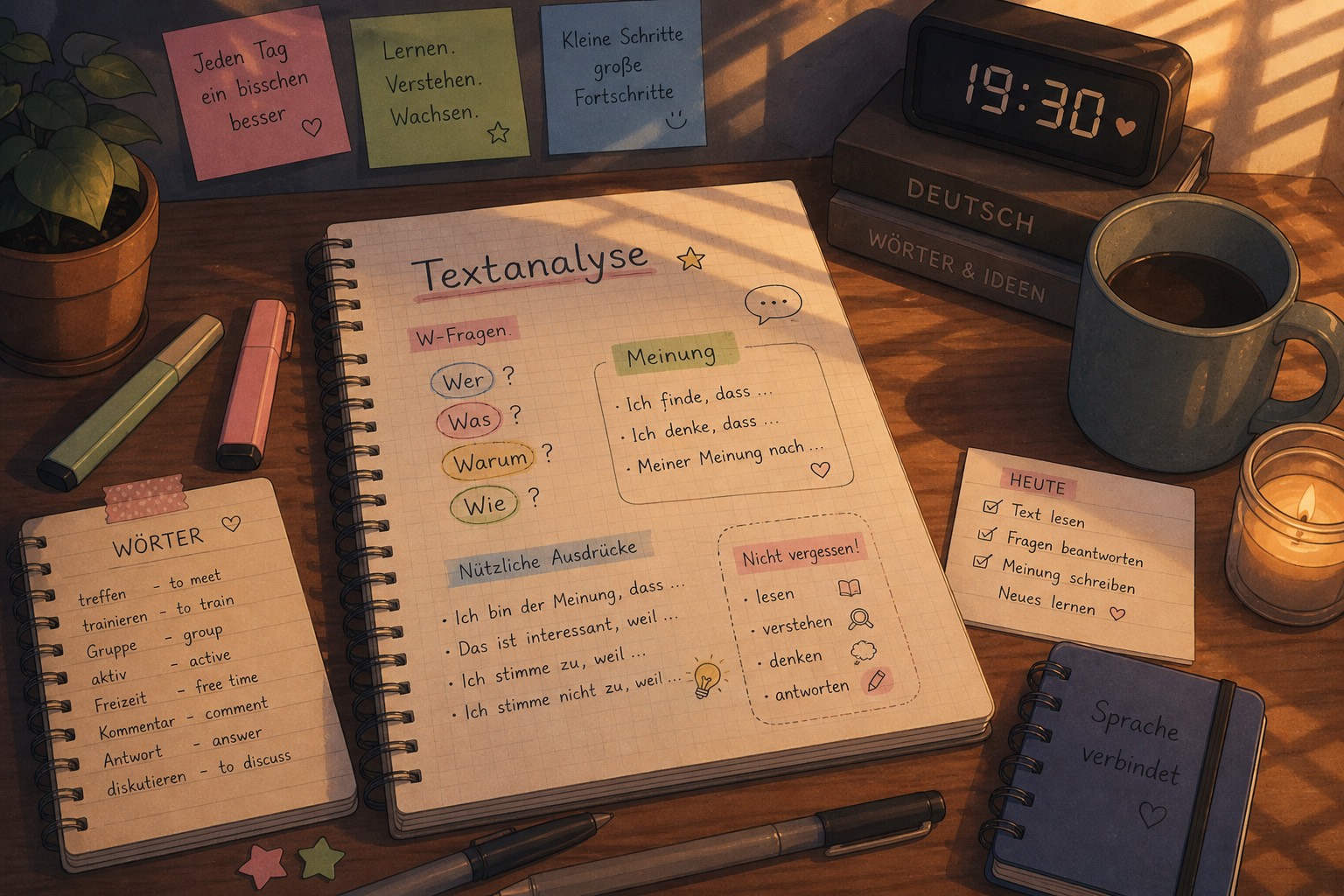
When I study German, I don’t just memorize words anymore. Instead, I work
with short texts and practice understanding how the language is actually
used. This method helps me move step by step from beginner to advanced
levels.
——————————
🧩 1. Start with the Main Idea (A1–A2)
First, I don’t try to understand everything. I focus on the general meaning.
I ask myself:
–
What is happening?
–
Who is speaking?
For example:
–
„Ich bin neu hier.“ → I understand: someone is new
–
„Wir sprechen im Kurs.“ → people talk in class
👉 At this level, recognizing simple sentences is enough.
——————————
🔍 2. Find Key Information (A1–B1)
Next, I look for important details in the text.
Typical patterns:
–
Wer? (Who?)
–
Was? (What?)
–
Warum? (Why?)
Examples:
–
„Wer schreibt den Beitrag?“
–
„Was machen die Leute?“
👉 I learn to scan texts instead of translating everything.
——————————
🧠 3. Learn Vocabulary in Context (A2–B1)
Instead of memorizing isolated words, I learn them inside sentences.
Examples:
–
„einen Text lesen“ → to read a text
–
„Fragen beantworten“ → to answer questions
–
„eine Meinung sagen“ → to give an opinion
👉 I connect meaning + usage together.
——————————
💬 4. Express Simple Opinions (A2–B2)
I start forming my own ideas:
–
„Ich finde das interessant.“
–
„Ich denke, das ist gut.“
–
„Ich bin nicht sicher.“
👉 This helps me move from passive understanding to active use.
——————————
🔄 5. Compare and Analyze (B1–B2)
Now I go deeper. I compare texts and responses.
I ask:
–
What is similar?
–
What is different?
Examples:
–
„Text A ist formell, Text B ist informell.“
–
„Die Personen reagieren unterschiedlich.“
👉 I begin to see patterns in communication.
——————————
🧑🤝🧑 6. Understand Interaction (B1–C1)
I analyze how people communicate:
–
„Er stellt sich vor.“ → he introduces himself
–
„Sie schreibt einen Kommentar.“ → she writes a comment
–
„Sie diskutieren im Kurs.“ → they discuss in class
👉 I understand roles and interaction.
——————————
🧩 7. Think Critically (B2–C1)
At higher levels, I reflect more deeply:
–
„Warum benutzt man Emojis?“
–
„Was ist die Absicht des Textes?“
–
„Wie wirkt die Sprache?“
Example answers:
–
„Der Text ist freundlich und informell.“
–
„Die Sprache ist einfach und direkt.“
👉 I move from understanding → analyzing → evaluating.
——————————
🎯 Learning Outcome
By using this method, I can:
–
A1–A2: understand simple sentences
–
B1–B2: analyze structure and meaning
–
C1: evaluate communication and intention
——————————
💡 Final Tip
Short, simple texts are powerful learning tools. When I analyze them step
by step, I improve faster than just memorizing vocabulary.

Leave a Reply