
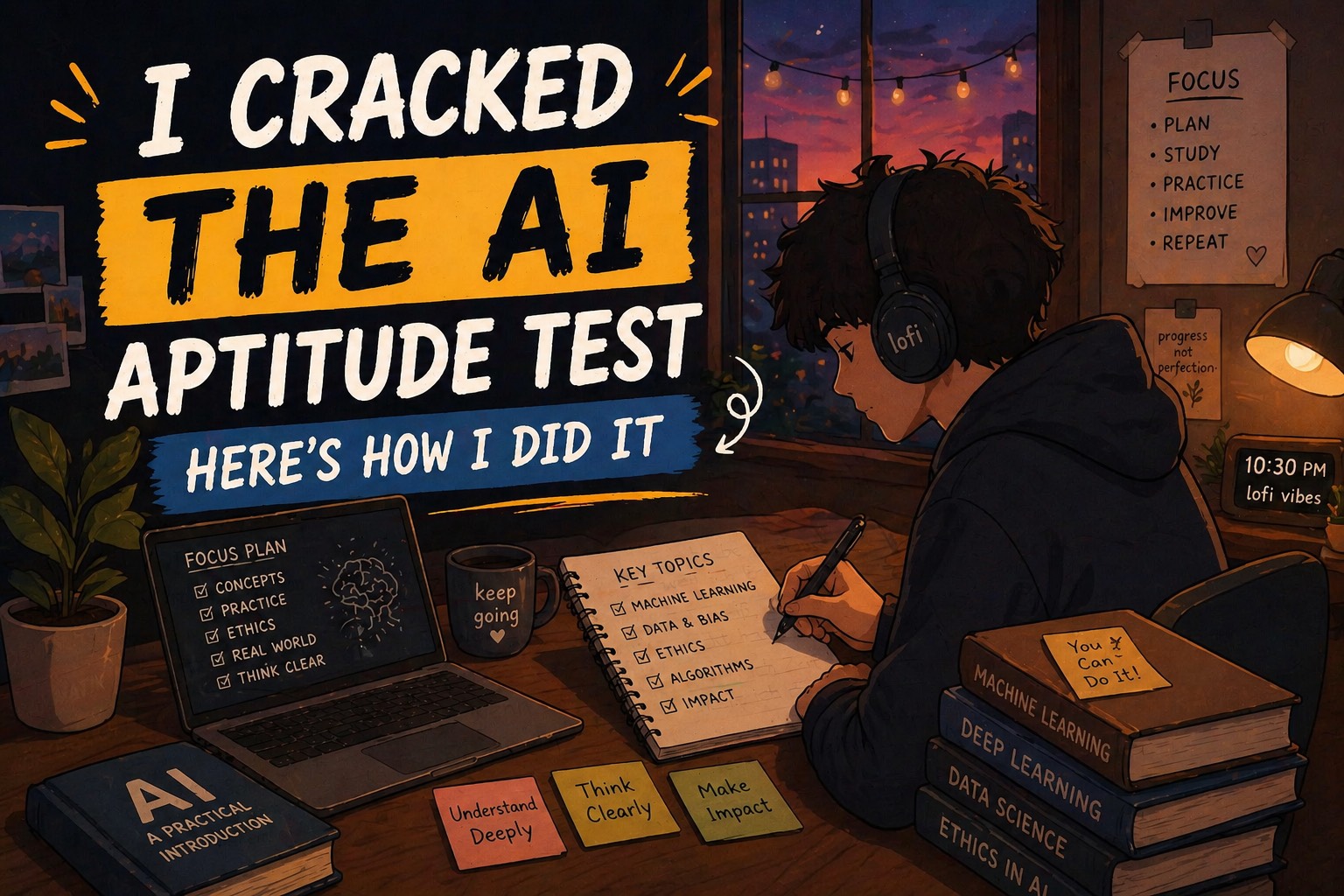
A practical first-person guide with clear, high-value insights
When I decided to apply for a master’s program focused on artificial
intelligence, I knew the aptitude test would be different from anything I
had done before. It wasn’t just about coding or math—it also required clear
thinking, ethical awareness, and real understanding of AI concepts.
At first, I felt overwhelmed. But once I changed my approach, everything
became much more manageable.
Here’s exactly how I prepared and what made the biggest difference.
——————————
😅 The challenge: More than just technical knowledge
I expected a purely technical test—but it turned out to be much broader.
I needed to understand:
–
machine learning basics
–
data and bias
–
real-world applications
–
ethical decision-making
👉 “I realized quickly that memorizing definitions wasn’t enough.”
——————————
🧠 Step 1: I focused on fundamentals
Instead of trying to learn everything, I focused on core ideas:
–
What does machine learning actually do?
–
How do models learn from data?
–
What is bias and why does it matter?
👉 “If I couldn’t explain it simply, I didn’t really understand it.”
This mindset helped me build a strong foundation.
——————————
📚 Step 2: I studied actively (not passively)
Before, I used to read or watch videos and move on. That didn’t work.
So I started asking myself:
–
Can I explain this in my own words?
–
Can I give a real-life example?
–
Can I apply this idea?
👉 “Learning became more effective when I started thinking, not just
consuming.”
——————————
🔄 Step 3: I practiced structured thinking
The test wasn’t only about answers—it was about how I think.
So I trained myself to:
–
break down problems step by step
–
compare different options
–
explain reasoning clearly
👉 “Clear structure = clear answers.”
——————————
⚖️ Step 4: I didn’t ignore ethics
One thing that surprised me was how important ethics is in AI.
I practiced thinking about:
–
fairness
–
transparency
–
responsibility
–
possible risks
👉 “Good answers often include both technical and ethical perspectives.”
——————————
✍️ Step 5: I practiced writing clearly
Even short answers matter. I focused on:
–
simple and clear sentences
–
logical structure
–
relevant points only
👉 “Clarity is more important than complexity.”
——————————
⚠️ Mistakes I avoided
Looking back, I’m glad I didn’t:
–
rely only on memorization
–
skip practice
–
ignore real-world applications
–
get stuck trying to be perfect
Progress came from consistent effort.
——————————
📈 Step 6: I tracked my progress
Over time, I noticed:
–
I understood concepts faster
–
I explained ideas more clearly
–
I felt more confident
👉 “Confidence came from preparation—not luck.”
——————————
🧩 What made the biggest difference
If I had to summarize, these helped me most:
–
understanding concepts deeply
–
practicing regularly
–
thinking in real-world contexts
–
staying consistent
——————————
✨ Final thoughts
Preparing for an AI aptitude test is not about knowing everything—it’s
about thinking clearly and understanding deeply.
👉 “Small, consistent steps lead to strong results.”
If you’re preparing right now, focus on:
–
fundamentals
–
structured thinking
–
real-world understanding
That’s what truly makes the difference.

Leave a Reply