
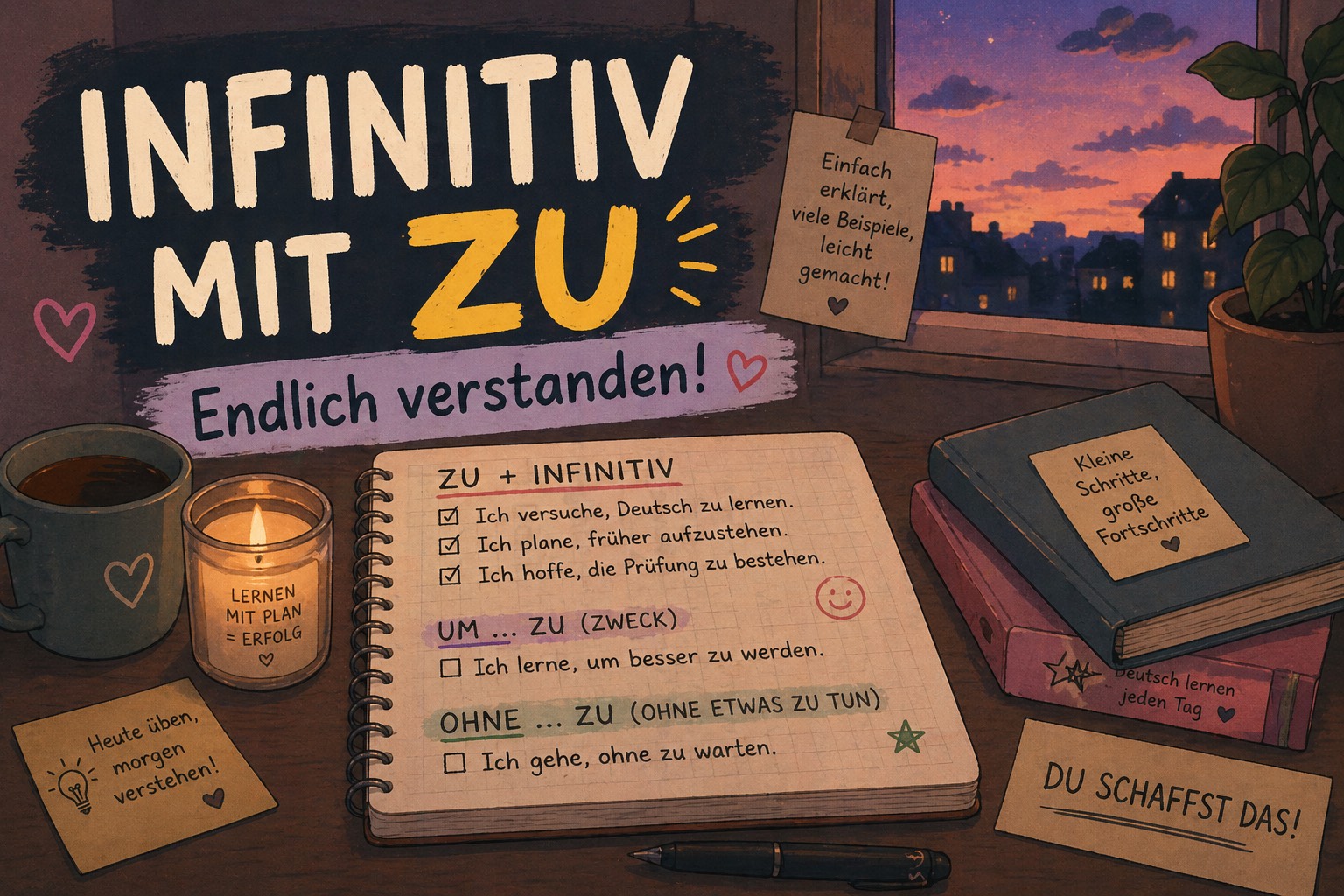
A simple first-person guide that made it clear
When I was learning German, one grammar topic kept confusing me: the
infinitive with “zu.” I saw it everywhere—zu lernen, zu arbeiten, zu
gehen—but I wasn’t sure when or how to use it correctly.
At first, I tried to memorize rules. That didn’t really help. What finally
worked was understanding how it’s used in real life and practicing with
simple sentences.
Here’s how I made it click.
——————————
😵 The problem: I didn’t know when to use “zu”
I often made sentences like this:
👉 „Ich versuche lernen Deutsch.“ ❌
👉 „Ich versuche, Deutsch zu lernen.“ ✅
I knew something was wrong, but I didn’t understand why.
——————————
🧠 Step 1: I learned the basic idea
The key insight for me was this:
👉 “zu + infinitive” = to do something
So instead of thinking in grammar rules, I thought in meaning:
–
lernen → to learn
–
zu lernen → to learn (as part of another idea)
Example:
👉 „Ich plane, Deutsch zu lernen.“
(I plan to learn German.)
That made everything easier.
——————————
📌 Step 2: I focused on common verbs
I noticed that certain verbs are often used with “zu”:
–
versuchen → to try
–
planen → to plan
–
hoffen → to hope
–
beginnen → to begin
👉 „Ich versuche, mehr zu üben.“
👉 „Ich plane, früher zu schlafen.“
Learning these patterns helped me a lot.
——————————
🔄 Step 3: I practiced with daily situations
Instead of random sentences, I used my own life:
👉 „Ich habe vor, früher aufzustehen.“
👉 „Ich versuche, weniger Stress zu haben.“
👉 „Ich hoffe, die Prüfung zu bestehen.“
Now it felt natural—not forced.
——————————
⚡ Step 4: I learned “um … zu” and “ohne … zu”
After that, I discovered two powerful structures:
👉 “um … zu” (purpose)
👉 „Ich lerne, um besser zu werden.“
(I study in order to improve.)
👉 “ohne … zu” (without doing something)
👉 „Ich gehe, ohne etwas zu sagen.“
(I leave without saying anything.)
These made my sentences more advanced instantly.
——————————
⚠️ Mistakes I avoided
Looking back, I’m glad I stopped:
–
translating word-for-word
–
ignoring commas
–
skipping practice
–
trying to learn everything at once
Grammar needs repetition and context.
——————————
💬 Simple formula that helped me
✅ Main verb + comma + “zu + infinitive”
👉 „Ich versuche, Deutsch zu lernen.“
👉 „Ich plane, mehr zu arbeiten.“
✅ um / ohne + “zu + infinitive”
👉 „Ich arbeite, um Geld zu verdienen.“
👉 „Ich gehe, ohne zu warten.“
Simple—but very effective.
——————————
📈 What changed for me
After practicing:
–
I spoke more fluently
–
My sentences sounded more natural
–
I understood texts better
👉 „Ich mache Fortschritte.“
(I’m making progress.)
——————————
🧩 Conclusion
Understanding “Infinitiv mit zu” changed how I build sentences in German.
It’s not just grammar—it’s a tool to express ideas clearly.
If you’re struggling, try this approach:
👉 Understand the idea → Practice with your life → Repeat daily
——————————
✨ Final thought
You don’t need to master everything at once.
👉 „Schritt für Schritt wirst du besser.“
(Step by step, you get better.)

Leave a Reply