
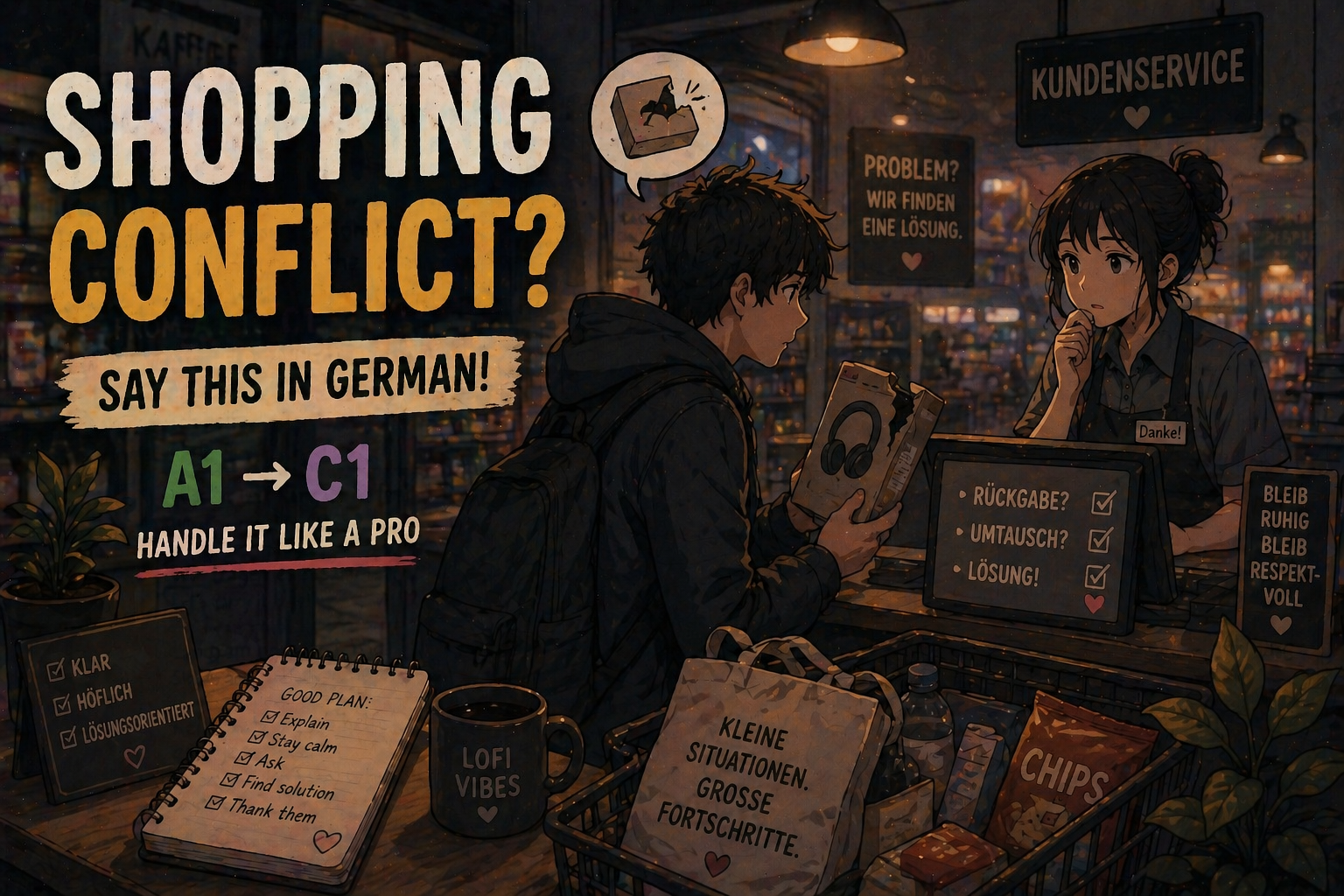
I used to think shopping was one of the easiest situations in a new
language—until something went wrong.
One day, I bought a product that didn’t work. What followed wasn’t just a
complaint—it became a real lesson in *communication, confidence, and
handling conflict in German*.
——————————
🟢 A1 – My First Reaction (Keep It Simple)
At the beginning, I didn’t have many words.
I walked back to the store and said:
– *„Problem.“*
– *„Kaputt.“*
– *„Sorry.“*
It wasn’t perfect, but it was enough to *start the interaction*.
👉 What I learned:
Even basic words can open the door. Silence is worse than simple language.
——————————
🔵 A2 – Explaining the Situation
Next time, I improved. I could explain a bit more:
– *„Ich habe ein Problem.“*
– *„Das Produkt ist kaputt.“*
– *„Ich möchte mein Geld zurück.“*
Now the staff understood me quickly.
👉 What changed:
I moved from *reacting* → *explaining clearly*.
——————————
🟡 B1 – Finding a Solution
At B1 level, I noticed something important:
It’s not just about complaining—it’s about *solving the problem together*.
I started saying:
– *„Ich möchte das zurückgeben.“*
– *„Haben Sie eine Lösung?“*
– *„Ich habe den Kassenbon.“*
The conversation became smoother, and the staff responded more positively.
👉 What I learned:
When you focus on solutions, the situation becomes easier for both sides.
——————————
🟠 B2 – Staying Calm and Professional
One day, the situation was more tense. The employee seemed stressed.
Instead of reacting emotionally, I stayed calm:
– *„Danke für Ihre Hilfe.“*
– *„Wir finden sicher eine Lösung.“*
– *„Ich verstehe die Situation.“*
This completely changed the tone of the interaction.
👉 What I realized:
How you speak is just as important as what you say.
——————————
🔴 C1 – Handling Conflict with Confidence
Now, I feel much more confident in these situations.
I can say things like:
– *„Ich verstehe, dass das passieren kann.“*
– *„Ich würde gern eine Rückerstattung oder einen Ersatz bekommen.“*
– *„Vielen Dank für Ihre Unterstützung.“*
The conversation feels natural, respectful, and effective.
👉 What this means:
I’m no longer just “surviving” the situation—I’m *handling it
professionally*.
——————————
🧠 My Personal Formula for Handling Conflict
Through experience, I developed a simple approach:
1. *Explain the problem clearly*
→ *„Das Produkt ist kaputt.“*
2. *Stay calm and polite*
→ *„Es tut mir leid, aber…“*
3. *Ask for a solution*
→ *„Was können wir machen?“*
4. *Show understanding*
→ *„Ich verstehe.“*
This works almost every time.
——————————
🌍 Real-Life Example
*Situation: Product doesn’t work*
❌ Before (A1)
*„Kaputt.“*
👉 Not wrong, but unclear and limited
——————————
✔️ Better (A2–B1)
*„Das Produkt ist kaputt. Ich möchte es zurückgeben.“*
👉 Clear and effective
——————————
✔️✔️ Best (B2–C1)
*„Das Produkt funktioniert leider nicht. Ich würde es gern zurückgeben oder
ersetzen lassen.“*
👉 Polite, professional, and solution-oriented
——————————
⚠️ Mistakes I Made Before
Looking back, I used to:
– get frustrated too quickly ❌
– speak too directly ❌
– forget polite phrases ❌
These made the situation harder than it needed to be.
——————————
✅ What I Learned
Handling conflict while shopping taught me more than vocabulary. It taught
me:
– how to stay calm
– how to communicate clearly
– how to work toward a solution
——————————
🎯 Final Thoughts
Your progress looks like this:
– A1 → say something
– A2 → explain
– B1 → solve
– B2 → manage calmly
– C1 → handle professionally
Now, when something goes wrong in a store, I don’t feel stressed anymore.
I see it as a chance to *practice real German in a real situation—and
improve every time*.

Leave a Reply