
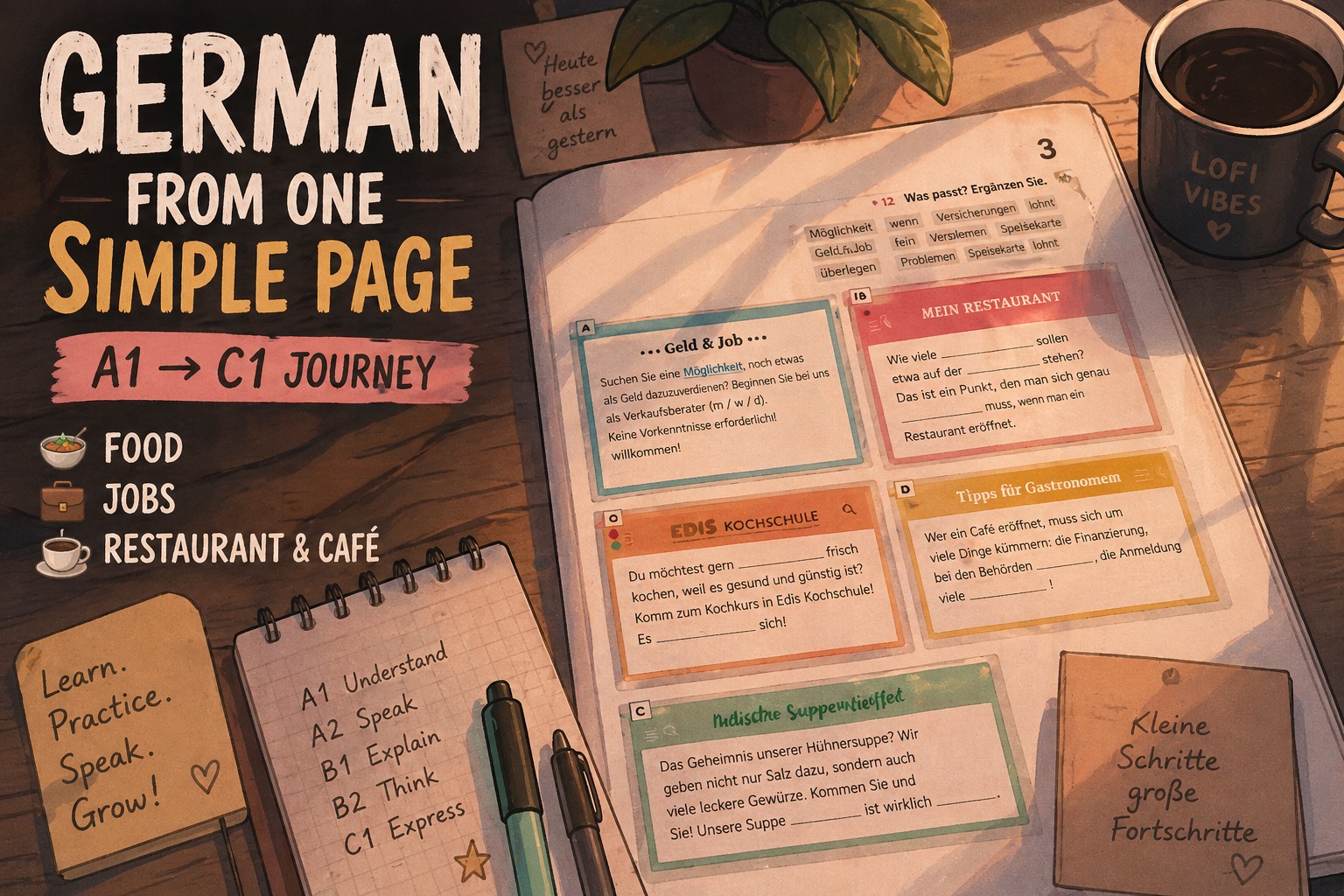
I didn’t expect much from that page.
It was just a normal exercise in my German textbook—something about food,
jobs, and restaurants. But when I actually sat down and worked through it,
I realized something important:
👉 even simple textbook content can become real-life language practice.
——————————
🟢 A1 – I Started with Just Understanding
At first, I focused on very basic words:
–
„Suppe“
–
„Kochschule“
–
„Job“
–
„Restaurant“
I didn’t try to speak in full sentences. I just wanted to recognize and
understand.
👉 My mindset:
“If I understand the words, I can build later.”
And that worked.
——————————
🔵 A2 – I Began to Form Sentences
After repeating the vocabulary, I started making simple sentences:
–
„Ich möchte einen Kaffee.“
–
„Ich suche einen Job.“
–
„Ich lerne Kochen.“
Now I wasn’t just reading—I was using the language.
👉 This was a turning point:
I moved from passive → active learning.
——————————
🟡 B1 – I Connected Ideas
At B1 level, the page became more interesting.
It wasn’t just words anymore—it was about real situations:
–
opening a café
–
working in a restaurant
–
learning how to cook
I started saying things like:
–
„Man kann in der Kochschule viel lernen.“
–
„Ein Restaurant zu eröffnen ist nicht einfach.“
👉 I was finally thinking in German—not translating.
——————————
🟠 B2 – I Thought Like in Real Life
Then I asked myself:
“How would I use this in real life?”
That changed everything.
Now I could say:
–
„Ich würde gern ein Café eröffnen.“
–
„Man braucht Geld und Erfahrung.“
–
„Gute Planung ist sehr wichtig.“
👉 The textbook became a real-life simulation.
——————————
🔴 C1 – I Expressed My Own Ideas
At the highest level, I stopped following the text.
I started creating my own thoughts:
–
„Ein eigenes Restaurant zu führen erfordert nicht nur Geld, sondern auch
Leidenschaft.“
–
„Die Erfahrung in einer Kochschule kann den Unterschied machen.“
Now I wasn’t learning German anymore—I was expressing myself in German.
——————————
🧠 What I Realized
That one textbook page taught me something powerful:
👉 Learning is not about the material
👉 It’s about how you use it
Even simple topics like:
–
soup 🍲
–
jobs 💼
–
cafés ☕
can become deep learning experiences.
——————————
⚠️ Mistakes I Made Before
Before this, I used to:
–
just read without speaking ❌
–
memorize without context ❌
–
skip simple exercises ❌
Now I do the opposite.
——————————
✅ What Works for Me Now
When I study, I always:
1.
Understand the words
2.
Make simple sentences
3.
Connect to real life
4.
Express my own ideas
This method works every time.
——————————
🎯 Final Thought
That page looked simple.
But it helped me go from:
–
A1 → understanding
–
A2 → speaking
–
B1 → explaining
–
B2 → thinking
–
C1 → expressing
Now I see every lesson differently.
It’s not just a textbook anymore—
it’s a tool to practice real life in German.

Leave a Reply