
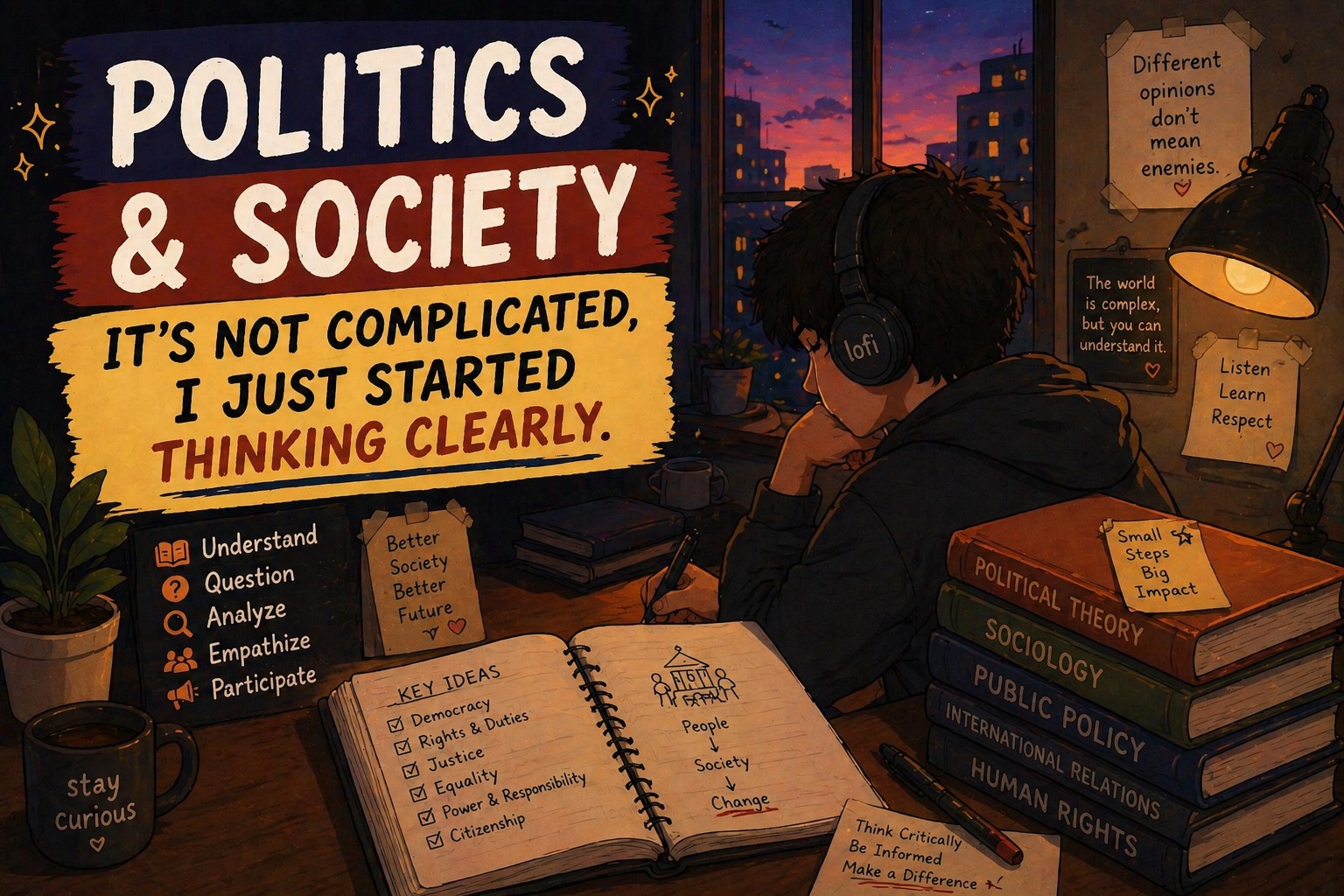
A simple first-person guide to thinking clearly about the world around me
For a long time, I avoided topics like politics and social science. It all
felt too complex—too many opinions, too many terms, and honestly, too much
noise.
But at some point, I realized something important:
these topics affect my daily life, whether I pay attention or not.
That’s when I decided to approach them differently—not as something
complicated, but as something I could understand step by step.
Here’s how I did it.
——————————
😅 The problem: It felt too complicated
At the beginning, I struggled with:
–
unfamiliar terminology
–
different opinions everywhere
–
difficulty forming my own view
👉 “I didn’t know where to start, so I avoided it.”
But avoiding it didn’t help—I just felt more disconnected.
——————————
🧠 Step 1: I focused on basic concepts
Instead of jumping into debates, I started with simple questions:
–
What is a government?
–
What is democracy?
–
What rights do citizens have?
👉 “I realized that understanding the basics makes everything easier.”
Once I understood the foundation, the bigger picture became clearer.
——————————
⚖️ Step 2: I learned to see different perspectives
One big change for me was accepting that:
–
people have different experiences
–
opinions are often shaped by context
–
there isn’t always one “right” answer
👉 “Understanding others doesn’t mean agreeing—it means thinking deeper.”
This helped me stay open-minded.
——————————
🔍 Step 3: I asked better questions
Instead of reacting emotionally, I started asking:
–
Who benefits from this decision?
–
Who might be affected negatively?
–
What are the long-term effects?
👉 “Good questions helped me understand complex issues.”
——————————
📚 Step 4: I connected theory to real life
I stopped seeing politics as abstract and started noticing it in everyday
situations:
–
public transport policies
–
education systems
–
job opportunities
–
social services
👉 “Politics is not far away—it’s part of daily life.”
——————————
✍️ Step 5: I practiced expressing my thoughts
At first, I hesitated to speak about these topics. But then I started:
–
writing short opinions
–
discussing with others
–
explaining ideas simply
👉 “Clarity came with practice.”
——————————
⚠️ Mistakes I avoided
Looking back, I’m glad I didn’t:
–
rely only on one source of information
–
react without thinking
–
avoid difficult topics
–
assume I knew everything
Growth came from curiosity.
——————————
📈 What changed for me
After changing my approach:
–
I felt more informed
–
I could follow discussions better
–
I developed my own perspective
👉 “Confidence came from understanding, not from knowing everything.”
——————————
🧩 Key lessons that helped me
If I had to summarize:
–
start simple
–
stay curious
–
think critically
–
listen to different views
–
connect ideas to real life
——————————
✨ Final thoughts
Understanding politics and society doesn’t require expertise—it requires
attention and willingness to learn.
👉 “You don’t need to know everything—you just need to start thinking.”
If you’re feeling overwhelmed, begin small.
Ask questions. Stay open. Keep learning.
That’s what made the difference for me.

Leave a Reply