
Talking About Art in Germany: My First Forays into Kunst im öffentlichen Raum
Okay, so, moving to Berlin was… a lot. Like, really a lot. The pace, the language, the sheer volume of history. But one thing that’s actually been surprisingly helpful – and honestly, kind of beautiful – has been trying to talk about the art I see all over the city. They call it Kunst im öffentlichen Raum – art in public spaces – and it’s everywhere! At first, I was completely lost, but I’m starting to get a handle on it, and I wanted to share what I’ve learned, mainly through awkward conversations and a whole lot of blushing.
The Initial Confusion: “Was ist das?”
The first few weeks, all I could really manage was a bewildered “Was ist das?” (“What is that?”) when I stumbled across a giant, stainless steel sculpture in a park. I felt incredibly stupid, and the people around me seemed to just… look at me. I quickly realized that wasn’t a common way to engage with art. My German wasn’t up to the task of a proper question.
I overheard a group of teenagers discussing a mural in Kreuzberg. They were saying something like, “Schau mal, die Farben sind unglaublich!” (“Look, the colors are incredible!”). I desperately wanted to join in, but I couldn’t even form a simple sentence. My attempts at “Es ist… schön?” (“It is… beautiful?”) just got blank stares.
Asking the Right Questions (and How to Actually Say “I Like It”)
I started to focus on building a small vocabulary. “Schön” (beautiful) is obvious, but it felt… flat. I heard someone say “interessant” (interesting) a lot, and it seemed to open up a bit more conversation. I learned to say “Ich finde es interessant” (“I find it interesting”) – much better than just pointing and mumbling.
I also picked up phrases like “Was meint ihr?” (“What do you think?”) which I quickly learned to use nervously, especially when facing a particularly bold piece. I once asked a woman sitting near a complex abstract installation, “Was bedeutet das?” (“What does this mean?”), and she just laughed and said, “Ach, da gibt es keine richtige Antwort! Es soll einfach gefallen!” (“Oh, there’s no right answer! It’s just supposed to be pleasing!”). That was a huge relief.
Real-World Scenarios: Asking Locals for Opinions
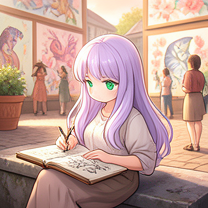
One day, I was sketching in Tiergarten – a massive park in the middle of the city – and I came across a bronze statue of a warrior. I wanted to understand it better. I approached an older gentleman who was sitting on a bench, reading a newspaper. I cautiously asked, “Entschuldigen Sie, könnten Sie mir sagen, was diese Statue darstellt?” (“Excuse me, could you tell me what this statue represents?”).
He looked up, peered at me, and said, “Ah, der ‘Kämpfer’! Er steht für den Mut und die Stärke der Berliner.” (“Ah, the ‘Fighter’! He stands for the courage and strength of Berliners.”) Then he launched into a whole explanation about the city’s history, which was fascinating, even if I didn’t understand everything. I managed a simple “Das ist sehr interessant, vielen Dank!” (“That’s very interesting, thank you very much!”)
Common Mistakes and Corrections
I made so many mistakes. For example, early on, I kept saying “Das ist sehr schlecht!” (“That is very bad!”) when I didn’t like something. Let’s just say, that didn’t go down well! A friendly gallery assistant gently corrected me, saying, “Nein, nein! Man sagt ‘Ich mag es nicht’ (“No, no! You say ‘I don’t like it’”) and pointed out that expressing a preference was much more polite.
Another thing – Germans really value directness. I once asked a security guard at a public art installation if he “liked” it. He raised an eyebrow and said, “Ich mag es nicht beurteilen.” (“I don’t want to judge it.”) It was a useful reminder that opinions about art can be complex and personal.
My Progress (and My Ongoing Challenges)
I’m still learning, definitely. I’m starting to recognize different styles and artists. I can now usually say, “Ich mag dieses Werk sehr” (“I really like this work”) without completely embarrassing myself. I even managed to have a brief, slightly awkward, but ultimately positive conversation with a group of students about a large, interactive installation near the Brandenburg Gate.
It’s still a work in progress, but talking about Kunst im öffentlichen Raum is helping me feel more connected to Berlin, to its history, and to its people. And who knows, maybe one day I’ll be able to offer a genuinely insightful observation – or at least, a politely phrased opinion – about a piece of art. Auf Wiedersehen for now!

Leave a Reply