
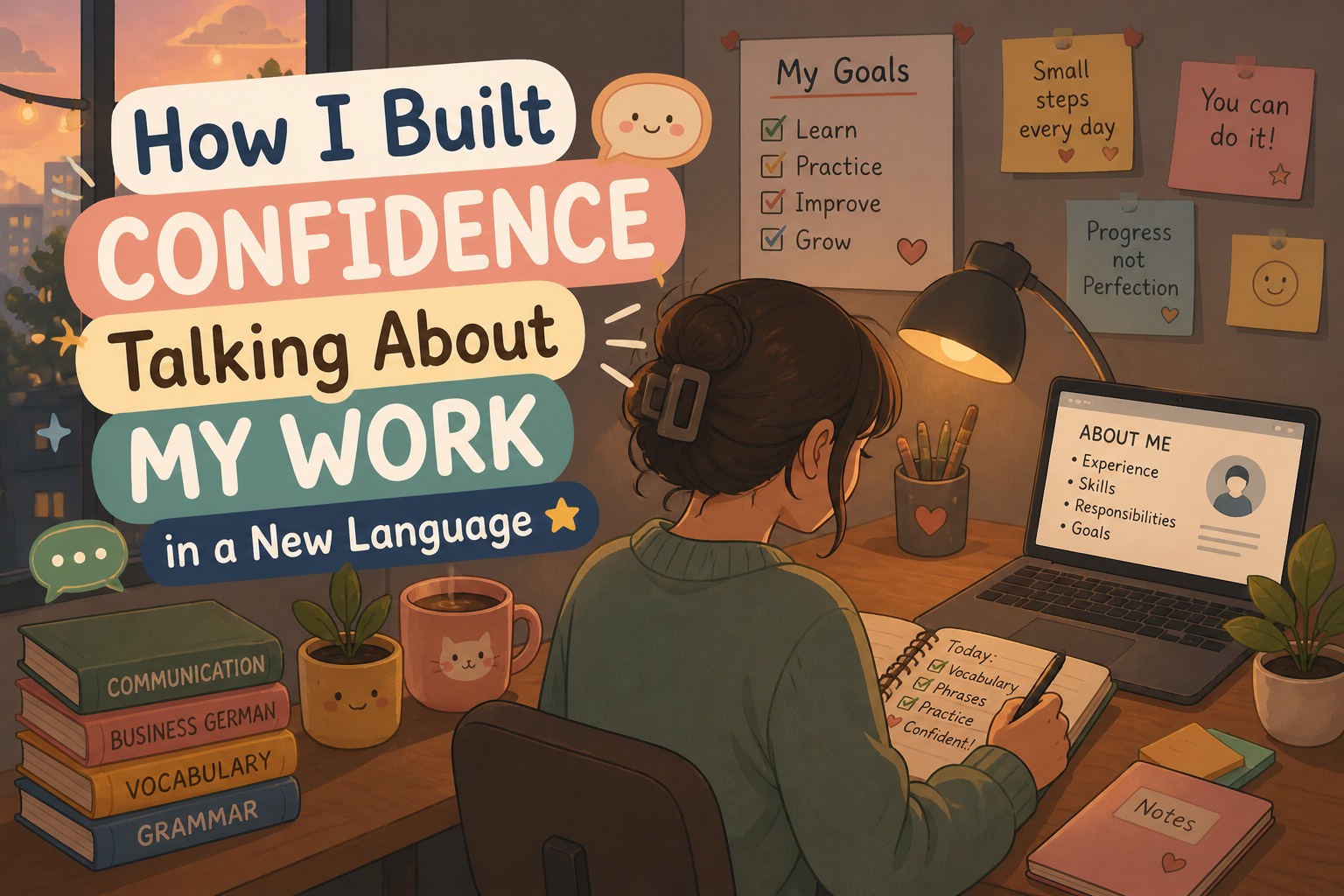
A practical first-person guide to speaking clearly about your experience
When I first tried to talk about my professional background in a new
language, I felt unsure. I knew my experience well, but I didn’t know how
to express it clearly.
I could say simple things, but when conversations became more detailed, I
hesitated.
👉 “I understood my work—but I struggled to explain it.”
Over time, I found a method that helped me speak more confidently and
naturally. Here’s what worked for me.
——————————
😅 The challenge: I knew my experience, but not the words
At the beginning, I had three main problems:
–
limited vocabulary for my field
–
difficulty forming longer sentences
–
fear of making mistakes
Because of this, I often avoided talking about my work.
——————————
🧠 Step 1: I simplified my introduction
Instead of trying to explain everything, I focused on a basic structure:
–
who I am
–
what I do
–
where I work
For example:
–
I describe my role clearly
–
I mention my experience step by step
👉 “Simple structure made everything easier.”
——————————
📚 Step 2: I learned key vocabulary for my field
I didn’t try to learn everything at once. I focused on:
–
common job-related words
–
daily tasks
–
basic professional phrases
This helped me:
–
understand conversations
–
respond more easily
👉 “Relevant vocabulary made a big difference.”
——————————
💬 Step 3: I practiced real-life scenarios
I practiced situations like:
–
introducing myself
–
talking about past experience
–
explaining my responsibilities
I repeated these regularly until they felt natural.
👉 “Practice made my answers faster and clearer.”
——————————
🔄 Step 4: I improved step by step
Instead of aiming for perfection, I:
–
added one new sentence at a time
–
improved my explanations gradually
–
learned from mistakes
👉 “Progress came from small improvements.”
——————————
🤝 Step 5: I focused on communication, not perfection
I realized that people don’t expect perfect language. They expect:
–
clarity
–
effort
–
communication
This changed my mindset.
👉 “Being understood is more important than being perfect.”
——————————
⚠️ Mistakes I avoided
Looking back, I’m glad I stopped:
–
memorizing long, complex texts
–
overthinking grammar
–
avoiding conversations
–
comparing myself to others
These habits slowed my progress before.
——————————
📈 What changed for me
After consistent practice:
–
I explained my experience more clearly
–
I felt more confident in conversations
–
I participated more in discussions
👉 “Confidence came from using the language regularly.”
——————————
🧩 Key lessons that worked
Here’s what helped me most:
–
keep explanations simple
–
learn useful vocabulary
–
practice real situations
–
improve step by step
–
focus on communication
——————————
✨ Final thoughts
Talking about your work in a new language can feel difficult at first—but
it gets easier with practice.
👉 “You don’t need perfect language—you need clear communication.”
Start small, stay consistent, and keep practicing. That’s how I
improved—and it can work for you too.

Leave a Reply