
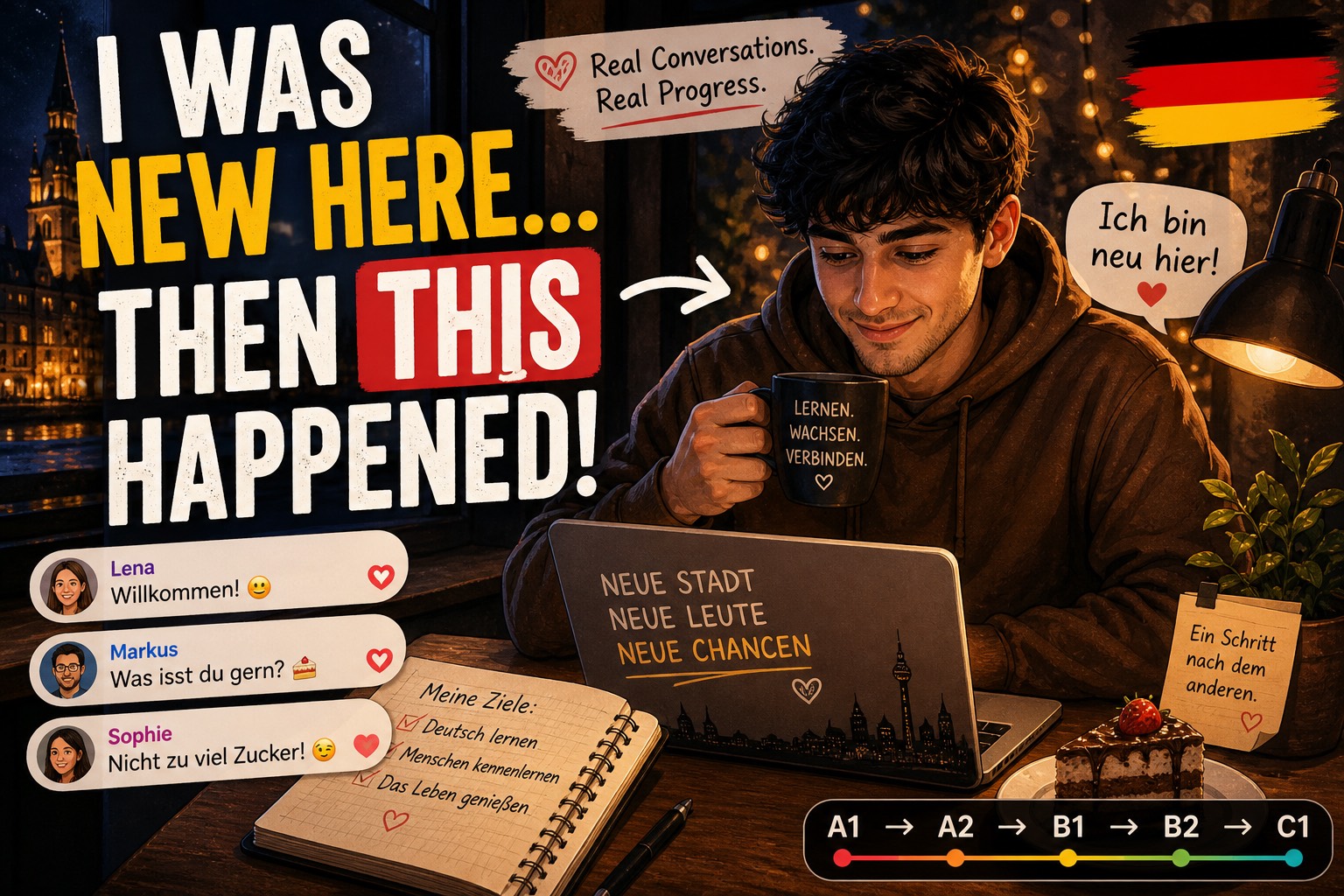
When I arrived in my new city, everything felt unfamiliar.
New streets, new people—and most challenging of all—a new language
environment. I realized quickly that learning German wasn’t just about
textbooks. It was about real interactions, even simple ones like
introducing myself online.
——————————
🟢 A1 – Just Saying Something
At the beginning, I kept things very simple.
I wrote a short introduction:
–
„Hallo, ich bin neu hier.“
That was it.
It wasn’t perfect, but it worked. People understood me, and some even
replied.
👉 What I learned:
You don’t need perfect grammar to start. You just need courage to say
something.
——————————
🔵 A2 – Sharing a Bit More
After that, I tried to add more details:
–
where I come from
–
where I live now
–
what I like
For example:
–
„Ich komme aus einem anderen Land.“
–
„Ich wohne jetzt hier.“
–
„Ich mag süßes Essen.“
Now the conversation started to feel more natural.
👉 I wasn’t just introducing myself—I was connecting with people.
——————————
🟡 B1 – Having Real Conversations
Soon, people started asking me questions:
–
„Was isst du gern?“
–
„Hast du Familie hier?“
At this stage, I could answer more clearly:
–
„Ich esse gern Dessert.“
–
„Meine Familie lebt auch hier.“
The interaction became more meaningful.
👉 I wasn’t just replying anymore—I was participating in conversations.
——————————
🟠 B2 – Understanding Tone and Culture
One thing surprised me: not all comments are serious.
Sometimes people joked, especially about food or habits.
For example, someone might say:
–
„Nicht zu viel Zucker!“
Instead of taking it negatively, I learned to respond politely:
–
„Ja, das stimmt 🙂“
👉 At this level, I learned something important:
It’s not just language—it’s also tone, humor, and culture.
——————————
🔴 C1 – Expressing Myself Naturally
Now I can express myself more freely:
–
„Ich freue mich, hier zu sein.“
–
„Ich entdecke gerade die Stadt und ihre Küche.“
–
„Ich habe schon viele nette Leute kennengelernt.“
The conversation feels real—not like practice.
👉 I’m not thinking about grammar anymore.
I’m just communicating naturally.
——————————
🧠 What This Experience Taught Me
This simple situation—introducing myself and talking about food—helped me
improve more than I expected.
I practiced:
–
introducing myself
–
answering questions
–
reacting to comments
–
understanding humor
——————————
⚠️ Mistakes I Made Before
Looking back, I used to:
–
wait until my German was “perfect” ❌
–
avoid talking to people ❌
–
overthink every sentence ❌
That only slowed me down.
——————————
✅ What Works for Me Now
Now I follow a simple approach:
1.
Start simple
2.
Add more details gradually
3.
Engage in conversation
4.
Stay relaxed and open
——————————
🌍 Why This Matters
Real language learning doesn’t happen only in books.
It happens when you:
–
introduce yourself
–
share your interests
–
respond to others
Even a small topic like food can lead to real connection.
——————————
🎯 Final Thought
That first simple message—
–
„Ich bin neu hier.“
—was the beginning of something bigger.
It helped me move from:
–
A1 → basic words
–
A2 → simple sentences
–
B1 → real conversations
–
B2 → understanding tone
–
C1 → natural communication
Now I don’t see these moments as “practice” anymore.
I see them as real life—and real progress in German.

Leave a Reply