
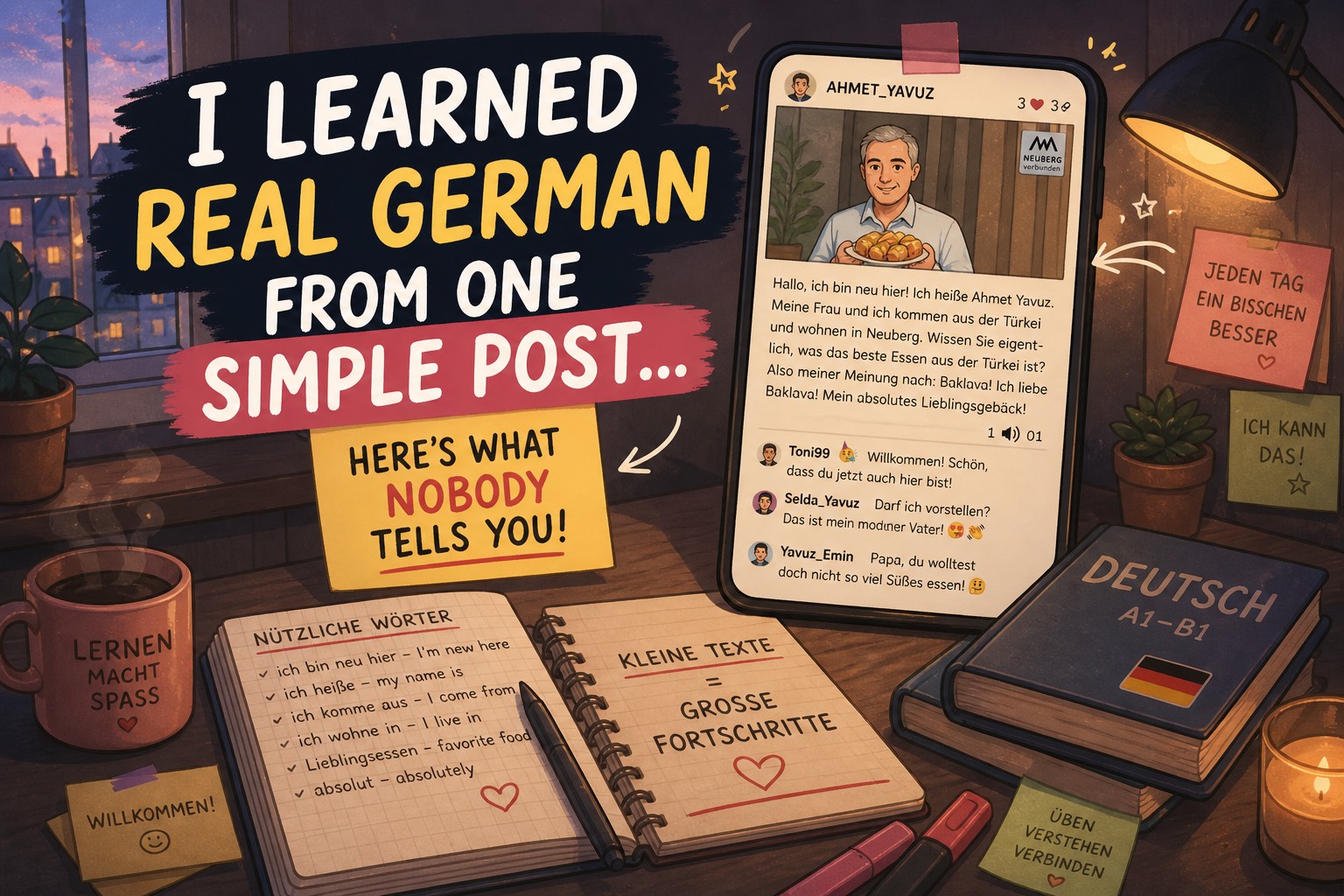
When I first came across a short German social media post like this, I
didn’t expect it to be such a useful learning tool. It looked simple—just a
person introducing himself and talking about his favorite food. But as I
read more carefully, I realized that texts like this are actually perfect
for building real-life language skills.
The post begins with a very common phrase: “Hallo, ich bin neu hier!” This
immediately tells me that the person is new to the platform or community.
What makes this powerful is its practicality. It’s exactly the kind of
sentence I can use myself in real conversations, whether online or offline.
Learning language through these natural examples feels much more meaningful
than memorizing isolated vocabulary.
As I continue reading, I notice basic but important structures such as “Ich
heiße…”, “Ich komme aus…”, and “Ich wohne in…”. These are essential
sentence patterns for introducing oneself. Seeing them used in context
helps reinforce how they actually work. Instead of thinking about grammar
rules, I start recognizing patterns that I can reuse with my own
information.
Another interesting aspect of the post is the cultural element. The writer
talks about food from his home country and shares his opinion: “Baklava!”
This adds personality to the text and shows how language is used to express
preferences. Food is a universal topic, and learning vocabulary in this
context makes it more engaging and easier to remember.
Below the main post, there are comments from other users. This is where the
text becomes even more valuable. Short responses like “Willkommen!” or
casual remarks from family members show how people actually interact in
everyday German. These small exchanges provide insight into tone,
friendliness, and informal communication.
What stands out to me most is that I don’t need to understand every single
word to grasp the meaning. By focusing on key phrases and familiar
structures, I can follow the overall message. Over time, this approach
helps me build confidence and improves my reading skills naturally.
Using simple, authentic content like this allows me to connect language
learning with real-life situations. It shows me how German is used beyond
textbooks—in introductions, conversations, and everyday interactions.
In the end, something as small as a short social media post becomes a
powerful learning resource. It combines vocabulary, structure, and culture
in a way that feels practical and easy to apply.

Leave a Reply