
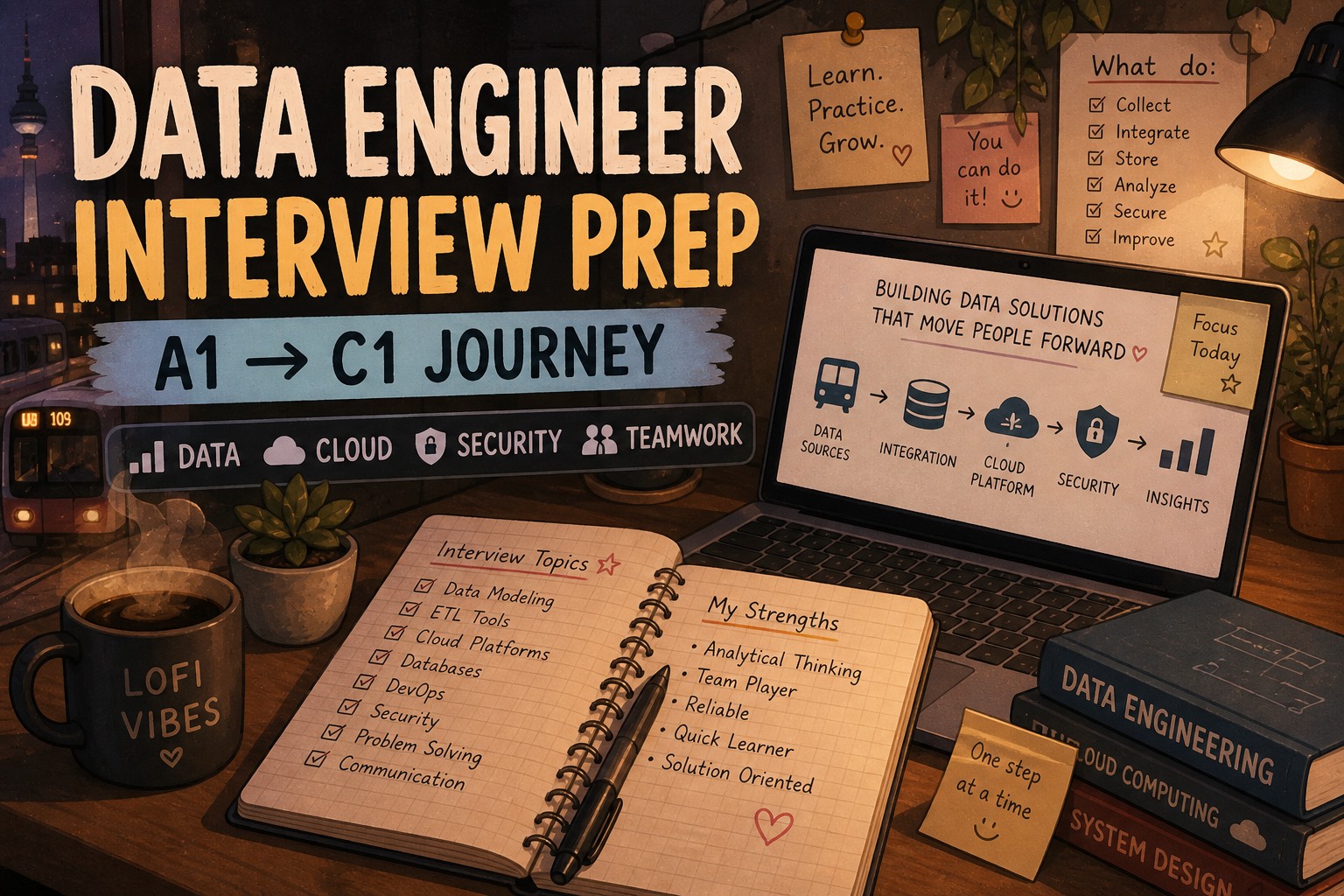
When I first read a job description for a Data Engineer role in a public
mobility setting, I didn’t just see requirements—I saw a roadmap for
learning German in a real professional context.
At first, it looked overwhelming: data systems, cloud platforms, security,
teamwork. But as I worked through it step by step, it became one of the
most practical learning experiences I’ve had.
——————————
🟢 A1 – Understanding the Basics
In the beginning, I focused on simple words:
–
„Daten“ (data)
–
„Team“ (team)
–
„Arbeit“ (work)
–
„Computer“ (computer)
I didn’t try to explain anything. I just wanted to recognize key terms.
👉 My goal at this stage:
Understand the environment, not everythingperfectly.
——————————
🔵 A2 – Talking About What I Do
Next, I started forming basic sentences about myself:
–
„Ich arbeite in der IT.“
–
„Ich arbeite mit Daten.“
–
„Ich nutze Cloud.“
Now I could answer simple questions. That gave me confidence.
👉 What changed:
I moved from knowing words → using them in context.
——————————
🟡 B1 – Explaining My Work
At B1 level, I began to describe my role more clearly:
–
„Ich arbeite mit Daten und Systemen.“
–
„Ich speichere und prüfe Daten.“
–
„Ich arbeite im Team.“
I could finally explain what I actually do.
👉 This was important:
I wasn’t just speaking—I was communicating meaning.
——————————
🟠 B2 – Thinking Professionally
Then I started thinking like someone already in the job.
I used more structured and professional language:
–
„Ich arbeite an Datenlösungen.“
–
„Ich analysiere Probleme und finde Lösungen.“
–
„Sicherheit ist sehr wichtig.“
I also became more aware of tone—being clear, calm, and professional.
👉 At this level:
Language becomes a tool for work, not just learning.
——————————
🔴 C1 – Expressing Ideas Confidently
At the advanced level, everything felt more natural.
I could say:
–
„Ich habe Erfahrung mit Datenintegration und Cloud-Technologien.“
–
„Ich optimiere Systeme und verbessere Prozesse.“
–
„Ich arbeite strukturiert und lösungsorientiert.“
Now I wasn’t just answering questions—I was presenting myself confidently.
——————————
🧠 What I Learned from This Process
This experience taught me something powerful:
👉 A job description is not just information
👉 It’s a real-life language training tool
From one text, I practiced:
–
vocabulary
–
sentence building
–
explaining technical ideas
–
professional communication
——————————
⚠️ Mistakes I Made Before
Before this, I used to:
–
memorize words without context ❌
–
avoid technical topics ❌
–
stay at simple sentences too long ❌
That slowed my progress.
——————————
✅ What Works for Me Now
Now I follow a simple method:
1.
Understand key terms
2.
Build simple sentences
3.
Explain your role
4.
Speak professionally
This turns any job description into a learning system.
——————————
🌍 Real-Life Impact
After practicing this way, I noticed:
–
I answer interview questions faster
–
I feel more confident speaking German
–
I understand professional texts better
Most importantly, I don’t feel stuck anymore.
——————————
🎯 Final Thought
That job description looked complex at first.
But it helped me move through all levels:
–
A1 → understand
–
A2 → describe
–
B1 → explain
–
B2 → communicate professionally
–
C1 → express confidently
Now I see every job post differently.

Leave a Reply